Updated On: October 30, 2025
How Long Does It Take To Charge An Electric Car: AC vs DC Explained

In Pakistan, electric vehicles (EVs) are beginning to make a mark. Transitioning to cleaner energy is becoming much easier, especially considering new entrants such as the MG ZS EV and the BYD Dolphin. One of the most common questions new EV owners have is, “How long does it take to charge an electric car?”
There are three determining factors when it comes to an EV charging time: the car battery size, the power output of the charger, and whether the charger is AC (alternating current) or DC (direct current). This guide is designed to understand EV charging time in Pakistan, AC vs DC charging and assist you in determining the optimal charging setup for your home, office or during long-distance travel.
What Determines How Long It Takes to Charge an Electric Car
Charging time will always have a range, and will differ to a degree due to various technical and general factors.
- Battery Capacity: The larger the battery is (kWh) the longer the charging time will be. Take the example of the Audi e-tron which has a battery size of 77 kWh, it will take double the time to charge as the 40 kWh Nissan Leaf, even if both are connected to the same charger.
- Charger Power Output: Most home chargers in Pakistan are between 7 kW and 22 kW (AC) and very fast EV chargers in public places go up to 360 kW (DC). Less power will always take more time to charge the battery.
- AC and DC Charging Types: Vehicles charge faster with direct current compared to alternating current since alternating current requires conversion to direct current within the vehicle.
- Charging During Different Temperatures: Charging efficiency can decline with warmer weather and lower voltage levels during Pakistan’s hot weather.
- Charging Environment: Compared to residential connections, the public EV charging stations in Karachi and Lahore offer much more stable and better power.
Common Types of EV Chargers in Pakistan

Pakistan’s EV market uses three charger levels.
Level 1 Charger
Level 1 chargers operate off the standard 220 V outlet in Pakistani homes and are suitable for occasional top-ups and overnight charging. Being the most inexpensive choice, it is also the slowest way to charge an electric car. It’s the most cost-effective option but also the slowest.
- 7 kW approx.
- Charging time is 6 – 8 hours for a full charge.
- Best for daily commuters driving under 80 km per day.
Level 2 Charger – The Smart Home Upgrade
Level 2 chargers are wall-mounted and work with a dedicated power line. They also reduce the time it takes to charge an electric car to within 4 – 6 hours to have a full battery. Due to their speed, safety, and cost efficiency, they are considered the best chargers for homes in Pakistan.
- Power: 7 – 22 kW
- Safety: Built-in surge and temperature protection.
- Features: Wi-Fi monitoring with smart timers.
DC Fast Chargers – Power on the Go
EV DC fast chargers transform electricity outside the vehicle and send direct current straight into the battery to charge an electric car. They are deployed on highways and in public charging infrastructures. Though costly to set up and maintain, for rapid charging in highly populated urban and inter-city areas, their utility is indispensable.
- Power: 24 – 360 kW
- Charging time: Up to 80% in 30 to 40 minutes.
- Best for: Long-distance journeys and commercial vehicle fleets.
AC vs DC Charging for EV – Which One Suits You Better?
Understanding the Key Difference
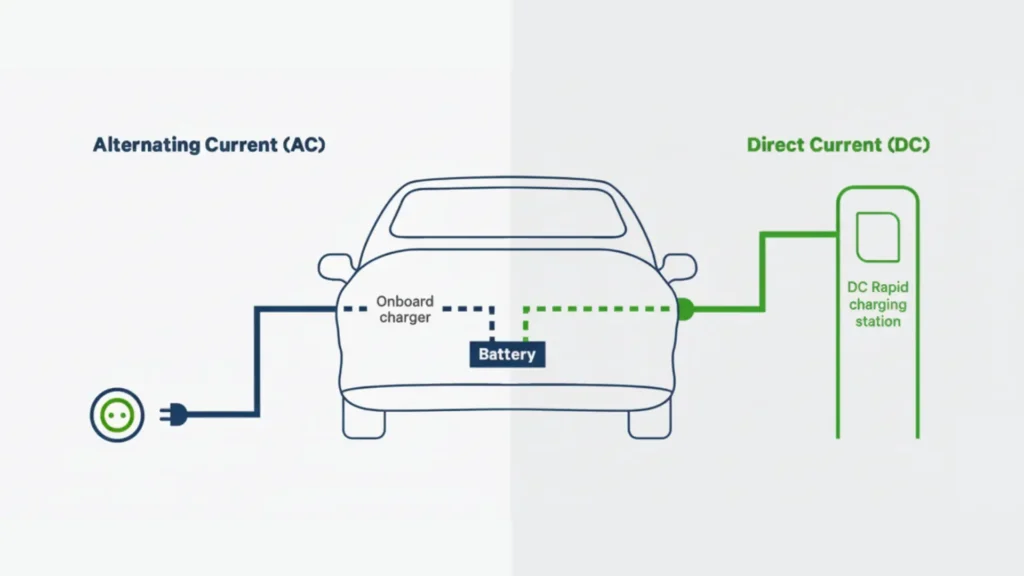
Where the power conversion happens is the main difference.
- AC (Alternating Current): Power from the grid is converted to DC in your car using an onboard charger before reaching the battery. This is slower but gentler on the battery, making it best EV charger for home.
- DC (Direct Current): Charging stations perform the conversion outside the car, so DC current can flow straight to the battery. This circumvents the onboard charger and dramatically quickens the charging.
AC charging is like filling a water bottle from a tap at home, while DC charging is like filling it with a pump at a gas station.
Speed and Convenience Compared
- AC Charging: This is the most affordable option. Quiet and easy to install at home. It will take longer (6–8 hours) but works best overnight.
- DC Charge: Perfect for highways and commercial stations without a long wait for a voltage of 20 mins to an hour for 80 %. More expensive, though.
Cost and Practical Use in Pakistan
AC EV chargers serve homes and apartment buildings, while DC EV car chargers cater to highways and urban charging networks.
- AC Charger Cost: Ranges between PKR 100K to 450K, depending on the charger’s origin (Chinese or European make) and its power rating. AC chargers are ideal for home, office, and semi-commercial use, offering a balance between affordability and reliable charging performance..
- DC Charger Cost: Starts from around PKR 2.8 million and can go up to PKR 10 million, depending on power capacity, features, and specifications. DC fast chargers are primarily used by public charging stations, dealerships, and commercial fleets for rapid, high-power charging.
- Electricity Cost: The average electricity cost for EV charging in Pakistan remains approximately PKR 25 to 35 per kWh, varying by location and tariff category.
How Long Does It Take to Charge Popular EVs in Pakistan
Formula to Estimate Charging Time:
You can estimate charging time using the following:
Time in hours = battery size in kWh / charger power in kW.
For instance, charging a 60 kWh battery with a 7 kW charger will take about 8.5 hours.
Choosing the Best EV Charger for Home
Level 2 Smart Charger is the best home EV charger, offering safety and a future-proof solution. For home charger purchasing, consider:
- Power rating: 7 – 22 kW chargers balance charging speed with grid load and home electricity usage.
- Plug compatibility: Most modern EVs use a Type 2 plug.
- Safety: Check for surge protection and a proper IP rating and certified wiring.
- Smart: App control, balanced load, and charging schedules optimize electricity usage.
- Warranty: Prefer local service brands with spare parts availability.
The Future of EV Charging in Pakistan
Pakistan continues to implement the National Electric Vehicle Policy (NEVP) for the country’s transition to electric vehicles (EVs) which includes incentives for the construction of charging stations and lowered import taxes for EVs and EV-related tools.
New charging stations are being installed in parking plazas, shopping centers, and on motorways in Karachi, Lahore, and Islamabad. Some private charging stations even offer smart payment reservations. In the next few years, expect to see DC fast chargers on every main road and affordable AC chargers in condominiums and housing societies. This will help people with EVs not to worry about charging stations being available.
Bottom Line
The answer to how long it takes to charge an electric car in Pakistan depends on the charger, your routine, and driving habits. For daily charging, home AC chargers are affordable and convenient and for road trips, DC fast chargers are more efficient. Both types of chargers will help develop the EV chargers in Pakistan. To learn more about home and public chargers designed with EV drivers in mind, visit Acharge Pakistan, and empower your driving.
Frequently Asked Questions (FAQs):
Which charging stations are better for EVs: AC or DC?
AC charging stations are great for everyday use because they are inexpensive, simple to set up, and gentler on battery health. DC chargers are more appropriate for long road trips or for use at commercial charging stations.
How long do DC EV chargers take to work?
DC Fast Charging (DCFC) can charge up to 80% in just 20–60 minutes, depending on the charger’s power and vehicle capacity. While earlier PHEVs didn’t support DC charging, newer models now include DC fast-charging capability, offering quicker and more flexible charging options for drivers.
Is AC charging good for the EV?
Yes, the AC charging method is the most common and safe method, and people use it at home and at the office. It takes advantage of your vehicle’s onboard charger, which converts AC to DC for the battery.
How do I calculate the charging time for my EV?
The formula is Battery size (kWh) ÷ Charger power (kW) = Charging time (hours). For example, a 50 kWh battery on a 10 kW charger takes about 5 hours
Can I charge my EV at home safely?
Definitely. For safe and efficient charging, use a certified Level 2 charger which is properly grounded and has MCB protection.
Will my batteries get damaged if I fast charge my DC device frequently?
Using DC charging once in a while is okay, but consistently fast charging may contribute to a small long-term loss of battery capacity. Where you can, invest in AC charging at home to take a break from fast charging.