Updated On: January 13, 2026
Electric vs Petrol vs Hybrid Cars vs PHEVs – Complete Comparison Guide
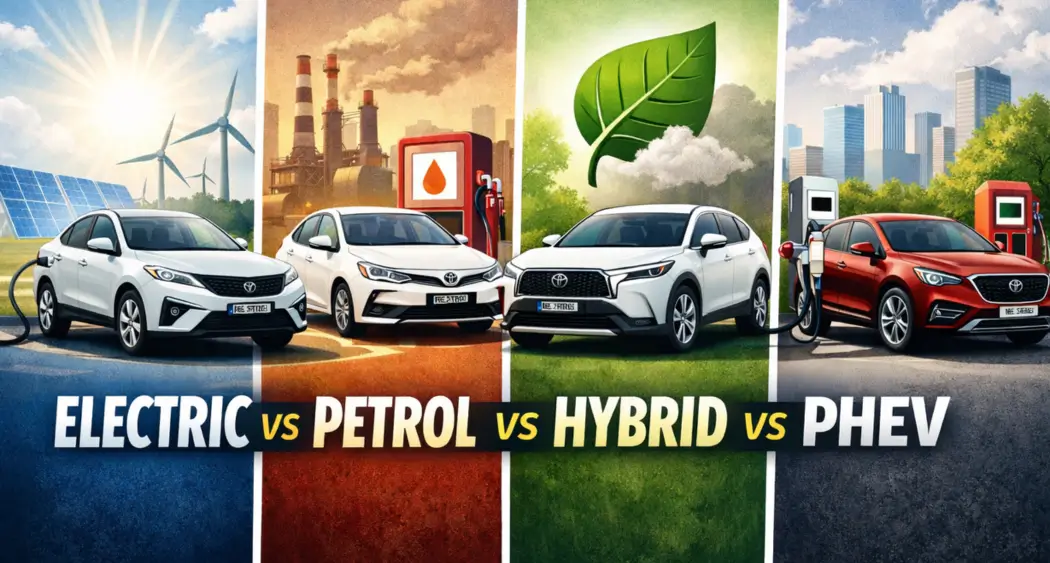
Finding the right car in Pakistan might have become even more difficult lately. Given the variety of options available to consumers today, whether they be hybrid cars in Pakistan, electric cars or even plug-in hybrid electric vehicles (PHEVs), consumers today have to make more decisions than ever before. The following will briefly outline the advantages and disadvantages of the four available options in order to make the decision easier on the individual buyer.
Understanding Different Car Types
Petrol Cars: The Traditional Choice
Petrol cars or combustion engine options have dominated Pakistan and the world for decades. They might be the most familiar option to most Pakistani drivers, but the ever-changing fuel prices and the costs associated with servicing the engine, changing oil, and replacing filters are compelling consumers to consider alternatives.
Electric Cars: The Future of Mobility
There are a growing number of EV cars on Pakistan’s roads today, including Riddara, Zeker, JAECOO J7 and BYD Seal, made available through partners like Capital Smart Motors (CSM) and Nexgen Auto in collaboration with Albario Engineering. These electric cars are far more environmentally friendly than combustion engine alternatives and are also much quieter. With the growing support from these partners, the availability of EVs is increasing, while the development of recharging infrastructure, such as charging pods, continues to expand to support wider adoption.
Hybrid Cars: Best of Both Worlds
Hybrid Cars integrate petrol engines and electric motors that don’t require external charging. The Honda HR-V e:HEV features three driving modes: electric for city driving, hybrid for quick acceleration, and petrol for steady highway cruising. This combination of features is making Hybrid Cars in Pakistan more and more preferred among drivers seeking optimal efficiency and freedom from range worry.
PHEV Cars: Maximum Flexibility
PHEV cars represent the most flexible, and in most ways, the best option. The MG HS PHEV (55 km electric range), Haval H6 PHEV (100+ km electric range), and BYD Shark 6 PHEV are all able to be charged externally and also run on petrol. The Changan Deepal S05 delivers 204 hp with 20-24 km/l efficiency in hybrid mode, which is ideal for daily driving and fuel-free commuting but also capable of distance driving.
Cost Comparison: Which is More Economical?
Cost Per KM for Petrol vs EV Cars
The cost per km for petrol vs EV cars explains the electric vehicle advantage. Fuel costs are about PKR 280 a liter, which means a regular petrol car with 12km/l on average is PKR 23 per km. Electric cars cost about PKR 4-6, when charged at home, and Hybrid cars cost on average PKR 12-15.
For PHEVs cars, costs depend on how you use them. Models like Changan Deepal S05 can get you 20-24 km/l in hybrid mode. If you regularly charge them and use them in electric mode, they can be as efficient as EVs.
Maintenance and Long-Term Costs
Electric cars have the most minimal maintenance as you don’t have to deal with oil changes or worrying about any moving pieces. Hybrid cars and PHEVs cars need electric system maintenance as well as traditional engine maintenance, but this will be less frequent than with pure petrol vehicles. Petrol cars will need to be serviced regularly every 5,000 to 10,000 km.
Environmental Impact
When it comes to tailpipe emissions, Electric cars will be the best option as they have none. Hybrid cars and PHEVs cars do less emissions than conventional cars, and this is more pronounced in city driving. Petrol cars do the most air pollution and also carbon emissions.
Range and Convenience
Petrol cars have the best range since there is fuel everywhere. Hybrid cars offer the same range as regular cars with the bonus of regenerative braking. PHEVs cars are also good since they have 40-100 km of electric range which is enough for most daily commutes and petrol backup.
Electric cars now offer competitive ranges, with models like the BYD Seal Premium reaching up to 650 km, and the growing network of charging stations in Pakistan is making long-distance travel increasingly convenient. Hyundai Ioniq 5 has a decent range of 384 km and has fast charging that can go from 10% to 80% in just 18 minutes. Companies like ACharge are filling the gaps in Pakistan’s charging network.
Comparison of Petrol, Electric, Hybrid, and PHEV Cars in Pakistan (2026)
| Category | Cost per km (PKR) | Maintenance | Range & Convenience | Environmental Impact | Pros | Cons |
|---|---|---|---|---|---|---|
| Petrol Cars | 23 per km (12 km/l at PKR 280/liter) | Regular servicing every 5,000–10,000 km | Best range; fuel widely available | High emissions & pollution | Familiar, widely available, long range | High fuel costs, high emissions, frequent maintenance |
| Electric Cars (EVs) | 4–6 per km (home charging) | Minimal; no oil changes or engine parts | Competitive ranges (384–650 km); growing charging network | Zero tailpipe emissions | Eco-friendly, low running cost, quiet | Initial cost higher, dependent on charging infrastructure |
| Hybrid Cars | 12–15 per km | Electric + engine maintenance (less frequent than petrol) | Same as petrol; regenerative braking | Lower emissions than petrol | Efficient, versatile driving modes, no range worry | More complex than petrol, higher cost than petrol |
| PHEV Cars | 12–24 per km (depends on electric vs petrol use) | Electric + engine maintenance | 40–100 km electric range + petrol backup; suitable for city & distance | Less emissions than petrol | Flexible, fuel-efficient, ideal for daily commute & longer trips | Initial cost high, requires charging for max efficiency |
Conclusion
When assessing the options of electric versus petrol cars, hybrid cars, and PHEVs cars, your driving behavior, budget, and concern for the environment must be kept in mind. Though petrol cars are the most budget-friendly, electric cars are the most fuel efficient and have the best cost per km for petrol vs EV cars. Both hybrid cars in Pakistan and PHEVs cars are reasonable options for drivers who are beginning to shift towards cleaner ways to drive. The more affordable EV cars in Pakistan are, the more they will be desired, especially with the increasing availability of EV charging stations. For a smarter, more cost-effective way to drive, explore your EV options and charging solutions with ACharge.
Frequently Asked Questions (FAQs):
What is the difference between hybrid cars and PHEVs?
Hybrid vehicles use regenerative braking to recharge their batteries and don’t require any outside charging. PHEVs have bigger batteries and can be charged externally.
What is cheaper to run in Pakistan, petrol cars or electric cars?
Electric cars are far cheaper to run than petrol cars, costing only 4 to 6 PKR per kilometer of travel, while petrol cars cost 23 PKR/km.
Which hybrid cars in Pakistan for 2026 are the best?
The best hybrid cars in Pakistan for 2026 are the Honda HR-V e:HEV, the MG HS PHEV, and the Haval H6 PHEV. They are efficient, reliable, and provide good electric ranges.
Do electric vehicles travel long distances in Pakistan?
Electric cars travel long distances in Pakistan. The Dongfeng 007 and BYD Seal Premium can both travel 650 kilometers, while the GUGO AION V can travel 600 kilometers.